
Robotic Knee Replacement Surgery
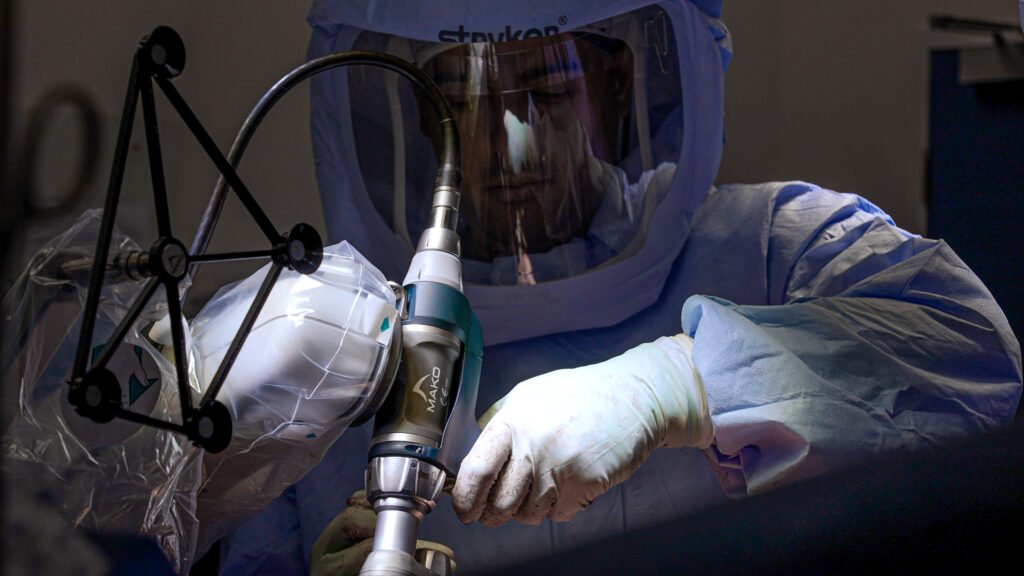
Robotic-assisted knee replacement surgery to support accurate implant positioning
Robotic knee replacement is a type of knee arthroplasty in which a robotic system assists the surgeon in planning and performing the procedure. The technology uses computer-aided mapping and a robotic arm to help guide surgical instruments with high precision. This process supports accurate removal of damaged bone and cartilage and assists in the positioning of the implant in line with your unique anatomy.
Compared to traditional methods, robotic-assisted techniques may improve implant alignment and soft tissue balance, which can support joint stability and long-term function. In some cases, this may also contribute to reduced post-operative pain and a quicker recovery.
Dr George Awwad offers robotic-assisted total and partial knee replacement surgery where appropriate. The approach is tailored using detailed imaging and planning software, and Dr Awwad will assess whether robotic technology is suitable for your needs during your consultation.
How robotic-assisted knee replacement works
Pre-operative planning
Intraoperative navigation
During the procedure, the robotic system provides real-time feedback to guide the surgeon in removing only the damaged bone and preserving healthy tissue. The robotic arm helps position the surgical instruments and implant components according to the preoperative plan, with fine-tuned precision that can adjust to soft tissue tension and joint balance.
Importantly, the robot does not perform the surgery on its own. Dr Awwad is in full control at all times and makes every surgical decision. The robotic system simply enhances the surgeon’s ability to work within millimetre-level accuracy, reducing variability and supporting consistent results.
Implant positioning
Accurate implant placement is critical to the success of knee replacement surgery. The robotic system assists in ensuring the implant fits the natural contours of your bone and is aligned properly to optimise movement and reduce stress on surrounding tissues.
By enhancing surgical planning and execution, robotic assistance may support a more personalised approach to joint replacement surgery, particularly in patients with complex anatomy or previous procedures.
Who may benefit from this technology
Robotic-assisted knee replacement may be suitable for a range of patients undergoing either total or partial knee replacement. It is designed to support greater accuracy and consistency in surgical technique, which may be particularly beneficial in certain situations.
Patients with early to moderate arthritis
Those with osteoarthritis confined to specific areas of the knee may be suitable for robotic-assisted partial knee replacement, where precision in implant sizing and positioning is especially important to preserve natural joint function.
Patients with complex anatomy or previous surgeries
Robotic technology can be helpful for patients who have unusual bone shapes, previous trauma, or anatomical changes from earlier procedures. The ability to plan surgery based on detailed 3D imaging may help reduce surgical challenges and improve implant alignment in these cases.
Active individuals and younger patients
Patients seeking personalised care
What to expect before, during, and after the procedure
Pre-operative preparation and planning
Before surgery, you will have a comprehensive consultation with Dr George Awwad, where your symptoms, diagnosis, and imaging (such as X-rays or CT scans) will be reviewed. If robotic-assisted surgery is being considered, you may require additional preoperative CT imaging to create a 3D model of your knee joint.
- Develop a personalised surgical plan
- Identify the optimal implant size and positioning
- Account for your unique anatomy and bone structure
- Fasting and medication instructions before surgery
- Prehabilitation and exercises (if recommended)
- Anaesthetic review and hospital admission process
What happens during robotic-assisted knee replacement
On the day of your procedure, you will be admitted to hospital and meet your surgical and anaesthetic team. The procedure is performed in a fully equipped operating theatre under general or spinal anaesthesia.
- Registration of the knee anatomy using robotic sensors and real-time tracking
- Verification of the pre-operative plan, with the ability to make fine adjustments based on soft tissue balance
- Robotic-guided bone resections to prepare the joint with sub-millimetre accuracy
- Implant positioning and kinematic/functional alignment, based on your unique knee dynamics
The robotic system does not perform the surgery independently, Dr Awwad remains in full control at all times, using the robotic arm as a precision tool to guide instrument placement and ensure accuracy.
Recovery and rehabilitation after surgery
- Pain management and wound care
- Early mobilisation with the physiotherapy team
- Discharge planning and home exercises
- Regain knee strength and flexibility
- Improve walking and balance
- Support a return to daily activities and long-term function
What is the difference between robotic-assisted, conventional, and PSI techniques?
Conventional Knee Replacement
In conventional total knee replacement, the surgeon uses standard surgical instruments and alignment guides during the procedure. This method relies on anatomical landmarks and experience to determine bone cuts and implant positioning. It has been used successfully for decades but may have limitations in precision, particularly in patients with abnormal anatomy or soft tissue imbalance.
Patient-Specific Instrumentation (PSI)
- Custom-fit planning: The guides are built using your own imaging data to reflect the shape and alignment of your knee.
- Improved efficiency: With detailed planning done in advance, PSI may support a more streamlined surgical process.
- Enhanced precision: By guiding bone resections, PSI helps the surgeon place the implant in alignment with your preoperative plan.
Robotic-Assisted Knee Replacement
Robotic-assisted surgery builds on the planning benefits of PSI and adds real-time intraoperative guidance. A robotic arm helps the surgeon make highly accurate bone cuts and fine-tune the position of the implant. Unlike PSI, robotic systems can respond to the patient’s actual soft tissue balance and anatomy during surgery, offering a more dynamic and personalised approach.
Comparing knee replacement technologies
Below is a general comparison of three commonly used surgical planning and execution methods in knee replacement: conventional techniques, patient-specific instrumentation (PSI), and robotic-assisted surgery. Each method offers distinct advantages, and Dr Awwad will recommend the most appropriate option based on your knee anatomy, condition, and goals.
| Feature | Conventional Knee Replacement | Patient-Specific Instrumentation (PSI) | Robotic-Assisted Knee Replacement |
|---|---|---|---|
| Planning method | Standard pre-op X-rays and templating | MRI or CT scans used to create custom guides | Advanced imaging creates a 3D model of your knee |
| Customisation | Based on general anatomical averages | Cutting guides tailored to your unique bone structure | Personalised 3D mapping and live intra-operative adjustments |
| Technology used | Manual tools and surgeon experience | Pre-made guides for cutting and positioning | Robotic arm guided by surgeon in real-time |
| Intra-operative adjustment | Full flexibility during surgery | Limited; guides are pre-manufactured | Surgeon can adjust based on real-time feedback |
| Soft tissue balancing | Performed manually by the surgeon | Manual, based on fixed guides | Dynamically assessed during surgery |
| Surgical precision | Relies on surgeon’s visual alignment | Improved bone resection accuracy | Potential for sub-millimetre implant positioning accuracy |
| Hospital & equipment costs | Standard | May involve imaging costs (CT) | May involve imaging costs (CT) |
| Suitability | Widely used, suitable for many patients | Good option for straightforward cases with predictable anatomy | Ideal for patients who may benefit from enhanced alignment or complex joint anatomy |
Which option is right for you?
Dr George Awwad will evaluate your condition, knee structure, and overall health to determine whether a conventional, PSI, or robotic-assisted approach is most appropriate for your surgery. In some cases, a combination of techniques may be used to personalise the procedure further.
Are there any drawbacks or risks with robotic-assisted surgery?
Surgical risks remain similar to conventional techniques
- Infection
- Blood clots (DVT or pulmonary embolism)
- Bleeding or wound healing issues
- Stiffness or reduced range of motion
- Implant wear or loosening over time
- Nerve or soft tissue injury (rare)
Technology-related considerations
- Not suitable for every patient: Robotic-assisted techniques may not be appropriate for all types of knee deformities or complex revision surgeries.
- Preoperative imaging requirements: Some robotic systems require additional imaging, such as a CT scan, which involves a small radiation dose and may not be suitable for everyone.
- Technology dependence: Although the robotic system is a tool under the surgeon’s control, there is a reliance on software and equipment functioning correctly on the day of surgery.
- Slightly longer operating time: In some cases, robotic-assisted procedures may take slightly longer due to setup and planning stages.